Silver’s march past $50 per ounce in 2025 reopened a debate many investors thought settled: can silver reach $100 per ounce within the next market cycle? This article explains why $100 is now on the table, what market and macro drivers would need to align, and which expert forecasts support — or contradict — a triple-digit outcome. Readers will learn how industrial demand, structural supply deficits, investor flows, and macro variables interact to push or cap silver prices, plus the concrete indicators to monitor in real time. The analysis draws on named expert opinions and consensus forecasts to map plausible scenarios, and it contrasts bullish outliers with mainstream bank expectations to help readers weigh probabilities. After outlining the recent breakout above $50, the article breaks down the primary drivers for $100 silver, profiles the main bulls, summarizes market consensus through 2026, explores macro and geopolitical levers, and finishes with a practical watchlist of indicators and thresholds to monitor going forward.
What Has Driven Silver’s Recent Breakout Above $50 per Ounce?
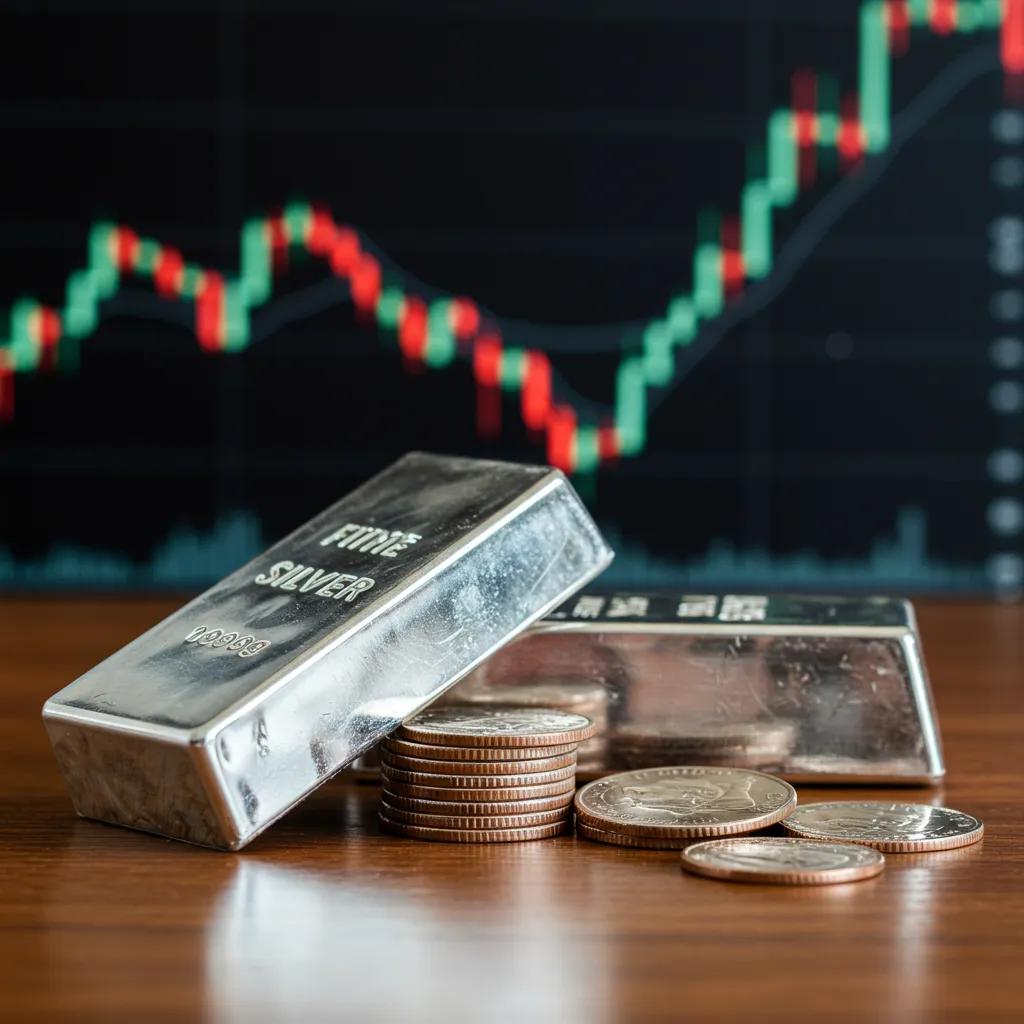
Silver’s breakout above $50 per ounce in 2025 reflected a convergence of technical momentum, visible physical tightness, and renewed investor interest. The immediate mechanism was a surge in investment flows into silver bullion and ETFs combined with signs of physical scarcity that pushed lease rates and prompt delivery premiums higher. This created a positive feedback loop: price rallies induced more ETF inflows and retail buying, which in turn exacerbated physical market strain and encouraged further speculative positioning. Understanding these structural and behavioral mechanics is essential before assessing whether momentum can carry prices toward $100, so the next section puts the 2025 move into historical context.
How Did Silver’s Price Perform in 2025 Compared to Historical Peaks?
Silver’s 2025 gains outpaced many recent cycles, producing a rapid move to new decade highs that re-opened comparisons with the 1980 and 2011 peaks. While the 1980 spike was driven by a cornering episode and the 2011 run reflected post-crisis monetary accommodation, the 2025 surge combined stronger industrial demand signals with concentrated investment flows and perceived monetary risk. This combination produced a steeper short-term percentage gain than most decade peaks, though the macro backdrop differs: inflation concerns and green-energy demand are more prominent in 2025. Comparing these episodes shows the price can spike quickly under stress, but sustainment to a much higher plateau requires persistent demand and limited supply response.
Why Is Breaking the $50 Resistance Significant for Silver’s Future?
Technically, moving decisively above $50 converted a long-term resistance band into potential support, altering many systematic and discretionary trading models that had capped upside. Psychologically, $50 functions as a milestone that broadens media attention and retail participation, inviting inflows from investors who use round-number targets. Structurally, the breakout signaled growing strain in deliverable supplies and raised lease-rate volatility, which can compress available physical inventory and amplify price moves. These dynamics mean that while the $50 break is necessary for a $100 scenario, it is not by itself sufficient — sustained industrial growth and ongoing investment demand must now combine with constrained supply to keep momentum intact.
What Are the Key Drivers Behind the $100 Silver Price Prediction?
The $100 silver thesis rests on a small set of interlocking drivers: expanding industrial demand (notably solar and EVs), persistent investment flows into physical silver and ETFs, structural supply constraints because much silver comes as a mining byproduct, and macro conditions such as inflation and a weak US dollar. Each driver magnifies price sensitivity in different ways: industrial adoption increases baseline demand, investment flows can create spike-oriented volatility, supply scarcity limits elastic responses, and macro shocks re-price precious metals as hedges. Below is a compact entity-attribute-value comparison of these primary drivers to clarify how each contributes to the $100 scenario and where the greatest leverage lies.
| Driver | Characteristic | Contribution to Price Pressure |
|---|---|---|
| Industrial demand (solar, EVs, electronics) | Growing baseline consumption measured in ounces | Raises structural floor for demand; high impact if adoption accelerates |
| Investment flows (ETFs, retail physical, futures) | Volatile, momentum-amplifying capital | Creates spikes and persistent upward pressure during inflows |
| Supply constraints (byproduct production, declining grades) | Limited elastic supply response | Prevents quick supply increases, sustaining deficits |
| Macro factors (inflation, dollar weakness, rate policy) | Broad market re-pricing mechanism | Can rapidly increase investment demand and hedge buying |
This table shows that industrial adoption and supply rigidity provide the durable pressure necessary to lift prices over time, while investment flows and macro shocks can trigger and accelerate rallies. The next subsection quantifies industrial demand mechanics and why they matter.
How Does Industrial Demand Influence Silver’s Price Outlook?

Industrial demand accounts for the majority of annual silver consumption and is concentrated in sectors that are growing rapidly, notably solar photovoltaic (PV) manufacturing and electric vehicles. Solar PV uses measurable silver content per panel, and as deployment targets rise, incremental ounces required scale quickly with capacity additions. EVs and electronics add further per-unit demand, and emerging technologies like next-generation batteries and certain data-center applications could increase usage or change substitution patterns. Because industrial demand tends to be less price-elastic than investment demand — manufacturers avoid substitution in many applications — rising industrial consumption can steadily raise the baseline demand and reduce the margin of supply safety, making large price moves more feasible if supply does not expand in tandem.
What Role Do Supply Deficits and Market Scarcity Play in Price Increases?
Supply deficits have been a recurring theme leading into 2025, with multiple years showing net deficits between mined supply plus recycling and total demand. Silver’s byproduct-dominant production profile means primary supply decisions are tied to base-metal economics, limiting silver’s independent supply response to price signals. Persistent deficits increase inventories drawdowns and put upward pressure on lease rates and prompt delivery premiums, signaling physical tightness. When lease rates spike and deliverable stocks thin, the paper market’s ability to meet redemption demands weakens, and that structural scarcity can amplify price moves — especially if investment demand surges simultaneously.
| Supply Metric | Description | 2025 Signal |
|---|---|---|
| Years of deficit | Consecutive annual supply shortfalls | Seven+ years of deficits magnify inventory drawdown |
| Production mix | Share of byproduct vs primary silver | High byproduct share reduces rapid supply response |
| Market tightness signals | Lease rates, prompt premiums, deliverables | Spikes indicate constrained physical availability |
This summary shows the supply-side mechanisms that raise the odds of sustained upward pressure; next, we profile the bulls who argue these mechanisms will push silver to $100.
Which Experts Predict Silver Will Reach $100 per Ounce and Why?
A minority of market voices have gone public with triple-digit silver forecasts, offering a range of rationales centered on structural deficits and accelerated industrial demand. These bullish experts emphasize persistent physical shortages, historically low inventories relative to demand, and macro conditions — such as inflation or central-bank policy — that could drive investors into precious metals. Their arguments often combine quantitative deficit narratives with qualitative judgments about market structure and investor behavior, producing timelines that vary from near-term spikes to multi-year appreciation. The compact expert comparison table below summarizes the forecasts, timeframes, and core rationales from the most-cited bullish commentators.
| Expert | Forecast & Timeframe | Rationale / Key Evidence |
|---|---|---|
| Philippe Gijsels (BNP Paribas) | “Macro conditions could double silver’s price by 2026” | Macro backdrop (inflation, policy) plus tight physical market could lift prices |
| Keith Neumeyer (First Majestic) | Triple-digit forecast (multi-year horizon) | Persistent supply deficits and physical shortage narrative; mining constraints |
| Ben McMillan (IDX Advisors) | $100 plausible soon with green transition | Industrial demand from solar/EVs and limited supply response drive higher prices |
This table clarifies how bullish forecasts align on structural scarcity and rising industrial demand, while differing on timing and the relative influence of macro triggers. The following H3s summarize each expert’s reasoning in more detail.
What Is Philippe Gijsels’ Forecast and Rationale for $100 Silver?
Philippe Gijsels has argued that prevailing macro conditions create a scenario where silver could double within a short horizon, and he frames this as “macro conditions could double silver’s price by 2026.” His rationale links elevated inflationary pressures and central-bank actions to renewed demand for precious metals as an inflation hedge, combined with constrained physical supply that reduces market elasticity. Gijsels emphasizes how coordinated macro uncertainty amplifies investor demand, which, when layered on top of an already tight physical market, could drive strong percentage gains. The core assumption is that macro risks persist long enough to shift investor allocations materially toward silver.
Macroeconomic Factors and Silver Prices: A Vector Autoregression (VAR) Analysis The investment demand for silver, particularly its role as a safe-haven asset, alongside global events such as financial crises or pandemics, can exert a significant influence on prevailing silver prices. Figure 1 illustrates the silver price trajectory from 2000 to 2022, noting a peak above $46 per ounce following 2009. Prices subsequently declined to below $20 per ounce before surging to $28 after 2019, coinciding with the COVID-19 pandemic. The price remained elevated amidst geopolitical tensions, including the conflict between Ukraine and Russia. This paper employs a Structural Vector Autoregression (SVAR) model, utilizing the silver price to estimate impulse response functions and variance decompositions. A macroeconomic viewpoint using a structural VAR analysis of silver price behaviour, Z Robinson, 2024
How Does Keith Neumeyer Justify a Triple-Digit Silver Price?
Keith Neumeyer builds a triple-digit case on the premise of a prolonged and structural physical shortage, arguing that years of supply deficits and limited deliverable stocks set the stage for a severe repricing once investor flows intensify. He points to the byproduct nature of most silver supply and declining ore grades as constraints that make production growth slow to respond to higher prices. Neumeyer’s narrative focuses on a “reckoning” between paper claims and physical ounces, where deliverability issues and concentrated holdings of physical silver could force a sharp revaluation. This thesis assumes that no rapid supply-side correction occurs and that investor demand remains elevated.
What Are Ben McMillan’s Views on Silver and the Green Energy Transition?
Ben McMillan highlights structural demand growth driven by the green energy transition, particularly additional silver used in solar PV production and, to a lesser extent, in certain EV components and electronics. He argues that as solar deployment scales to meet decarbonization goals, the cumulative incremental ounces required could materially tighten the market relative to existing supply forecasts. McMillan stresses that even modest per-panel or per-vehicle ounces, when multiplied by global deployment figures, can create meaningful new demand. His caution is that timelines and adoption rates are key uncertainties, and the $100 pathway assumes faster-than-expected industrial uptake.
What Is the Market Consensus on Silver’s Price Outlook Through 2026?
Most mainstream analysts and banks remain more conservative than the outlier bulls, pointing to a tactical range that assumes some supply response and moderated macro volatility. In short, “Most banks and mainstream analysts expect a $50–$65 range through 2026.” This consensus reflects assumptions about continued but not runaway industrial demand, an eventual modest supply response or recycling uptick, and central-bank policies that stabilize inflation and real yields. Presenting consensus forecasts side-by-side helps readers see why the $100 scenario diverges: the consensus assumes partial normalization of macro risks and more elastic supply/demand dynamics.
| Analyst / Bank | Forecast Range (through 2026) | Main Assumptions / Risks |
|---|---|---|
| Mainstream Banks (aggregate) | $50–$65 | Stable industrial demand growth, some supply/recycling response, moderated inflation |
| Cautious Strategists | $45–$60 | Higher real yields limit precious-metals demand; dollar resilience |
| Bullish Outliers | $80+ / $100 possible | Persistent deficits + accelerated industrial & investment demand |
This comparison underlines that mainstream forecasts hinge on a balance between demand growth and some degree of supply or recycling response, making $100 an outlier outcome under their models. The next H3 explains the specific assumptions that push analysts toward the $50–$65 band.
Why Do Most Analysts Expect Silver to Stay Between $50 and $65?
Analysts projecting the $50–$65 band typically embed conservative macro scenarios and assume partial supply-side mitigation, such as increased recycling or marginal production rises tied to base-metal economics. They often model moderate industrial growth rather than sharp accelerations, and they anticipate central-bank actions that prevent prolonged high inflation or a sustained weak dollar. Risk management considerations and historical volatility profiles lead many institutions to prefer restrained base-case forecasts, treating triple-digit outcomes as low-probability tail scenarios rather than central estimates. These assumptions produce a cautious outlook that leaves room for upside shocks but regards them as contingent on multiple adverse alignments.
Forecasting Silver Prices: An ARIMA Model Approach and Future Research Directions This study aims to comprehensively examine and forecast future silver prices within the Indian context. Recognizing silver’s historical significance as a valuable commodity for over 6,000 years, this research sought to elucidate the intricate price movements influenced by a multitude of factors. While acknowledging the complexity of these patterns, the primary objective is to illuminate the principal drivers of silver price fluctuations. The Autoregressive Integrated Moving Average (ARIMA) model was employed. This model meticulously integrates Autoregression and Moving Average components, contingent upon data stationarity. The research methodology is structured into four distinct phases: identification, estimation, diagnostics, and forecasting, all executed using the ARIMA (p, d, q) framework. The ARIMA model accounted for approximately 26% of the observed variance in silver prices, suggesting the presence of additional significant factors not captured by the model. The research underscores the multifaceted nature of factors influencing silver prices and highlights the necessity for a more holistic understanding. This study contributes to the field by introducing a proposed conceptual framework that integrates Google Trends analytics and an extensive literature review. This novel methodology is designed to investigate the primary determinants of silver prices and their complex interdependencies. By laying the groundwork for subsequent investigations, this study advances the ongoing discourse on silver price analysis and forecasting. Forecasting silver prices: a univariate ARIMA approach and a proposed model for future direction, C Bagrecha, 2025
What Are the Main Risks That Could Prevent Silver from Reaching $100?
Several credible downside scenarios can derail a rally: demand destruction or substitution in industrial uses, a faster-than-expected supply response including recycling, aggressive monetary tightening that bolsters real yields and the dollar, or an economic slowdown that reduces both industrial and investor appetite for commodities. Analysts also point to potential sentiment reversals and rapid profit-taking that could collapse momentum before structural realignment occurs. Each of these risks can interact — for example, a stronger dollar combined with a manufacturing slowdown would likely compress both industrial and investment demand simultaneously, greatly reducing the probability of a sustained run toward $100.
How Do Macroeconomic and Geopolitical Factors Affect Silver’s Potential Rally?

Macro and geopolitical uncertainty function as amplifiers for precious metals by shifting capital toward tangible stores of value and by creating supply interruptions that raise scarcity fears. The key macro channels are inflation expectations, real interest rates, and US dollar directionality; each alters the opportunity cost of holding metals and the relative attractiveness of silver as an inflation hedge. Geopolitical shocks — such as regional conflicts or major supply-chain disruptions — can trigger rapid demand for physical metals as safe havens, particularly in markets where local currency volatility or import disruptions make tangible assets more valuable. Understanding these mechanisms is crucial to judging whether a short-lived spike or a durable rally is more likely.
How Do Inflation and US Dollar Movements Impact Silver Prices?
Inflation expectations and US dollar movements are primary macro drivers because silver is priced in dollars and competes with interest-bearing assets. A weaker dollar typically lifts dollar-denominated commodity prices, while lower real yields reduce the opportunity cost of holding non-yielding assets like silver, boosting investment demand. Conversely, rising real yields and a stronger dollar can suppress precious-metal prices by making bonds more attractive and reducing hedging demand. Short-term CPI surprises or central-bank shifts can therefore trigger sharp movements; over longer horizons, persistent trends in inflation and real yields determine whether investor allocations to silver rise or fall.
The Influence of Exchange-Traded Funds on Price Discovery in Gold and Silver Markets This study investigates the relationship between exchange-traded funds (ETFs) for gold, silver, and oil, and their respective futures instruments and underlying commodities, utilizing intraday data. Employing tracking error and pricing deviation metrics, we observe that gold, silver, and oil ETFs closely mirror the performance of their underlying assets. It is well-established in financial literature that price discovery primarily occurs within the futures market. We therefore examine whether the recent emergence of ETFs has altered the futures market’s dominant role in price discovery. Our findings indicate that the availability of ETFs has shifted price discovery for gold and silver towards the ETF market, whereas in the oil market, price discovery remains predominantly situated in the futures market. The influence of ETFs on the price discovery of gold, silver and oil, 2013
What Geopolitical Events Could Drive Silver as a Safe-Haven Asset?
Geopolitical events that threaten supply chains, disrupt mining regions, or generate broad market panic can push investors toward physical metals. Examples include prolonged regional conflicts that interrupt mineral exports, trade disruptions that constrain industrial supply chains, or systemic financial stress that undermines confidence in paper assets. In such episodes, investors often seek liquid, tangible stores of value — and silver, with both industrial and monetary demand profiles, can attract flows from both practical and speculative buyers. The magnitude and duration of price reactions depend on event severity and whether supply channels are directly impaired or investor risk-off behavior predominates.
What Are the Key Indicators and Conditions to Watch for $100 Silver?
To judge whether $100 is becoming likely, monitor a concise set of indicators that together reveal whether demand, supply, and macro conditions are aligning. Embed the prescriptive checklist that follows into regular market monitoring routines: “Indicators to monitor: industrial demand metrics, supply deficit size, lease rates, ETF flows, dollar and real yields.” Watching these metrics in combination — rather than in isolation — gives a clearer signal about trajectory and timing. The checklist below lists quantifiable thresholds and trend signals that would materially raise the probability of a sustained rally toward $100.
The following checklist identifies the specific trend signals that would support a sustained move toward $100, with quantifiable examples where applicable.
- Sustained ETF inflows: Net inflows into silver ETFs exceeding historical norms for consecutive quarters, indicating persistent investor demand.
- Multi-year supply deficits: Continued net deficits measured in tens of millions of ounces over multiple years, tightening inventories.
- Lease-rate and delivery stress: Persistent lease rates spikes and reduced deliverable inventories that indicate physical scarcity.
Monitoring these three items together helps distinguish a speculative spike from a durable market re-pricing. The next subsection expands the industrial and investment trend signals to watch.
Which Industrial and Investment Trends Will Signal a Rally to $100?
Key industrial milestones include accelerated solar PV deployment beyond baseline forecasts and higher per-unit silver content in new technologies; on the investment side, sustained ETF inflows and growing retail bullion demand matter most. Quantifiable triggers that would be bullish include multi-quarter ETF inflows at levels that historically preceded major rallies, solar demand estimates materially above consensus, and visible increases in recycling that nevertheless fail to offset primary deficits. These signals combined suggest both durable baseline demand growth and elevated investor appetite — a necessary pairing for a move toward $100.
How Can Supply Changes and Market Sentiment Influence Silver’s Trajectory?
Supply-side surprises can either accelerate or derail a rally: new primary silver projects, unexpectedly large recycling flows, or rapid increases in byproduct supply could ease tightness, while mine disruptions or ore-grade declines can tighten markets further. Sentiment indicators such as options skew, positioning reports, and retail buying trends provide early warnings of speculative froth or capitulation. Monitoring lease rates, prompt delivery data, and ETF holdings offers practical insight into physical market stress and investor positioning; when these indicators show coordinated tightening and bullish positioning, the odds of a sustained, higher-price regime increase significantly.